
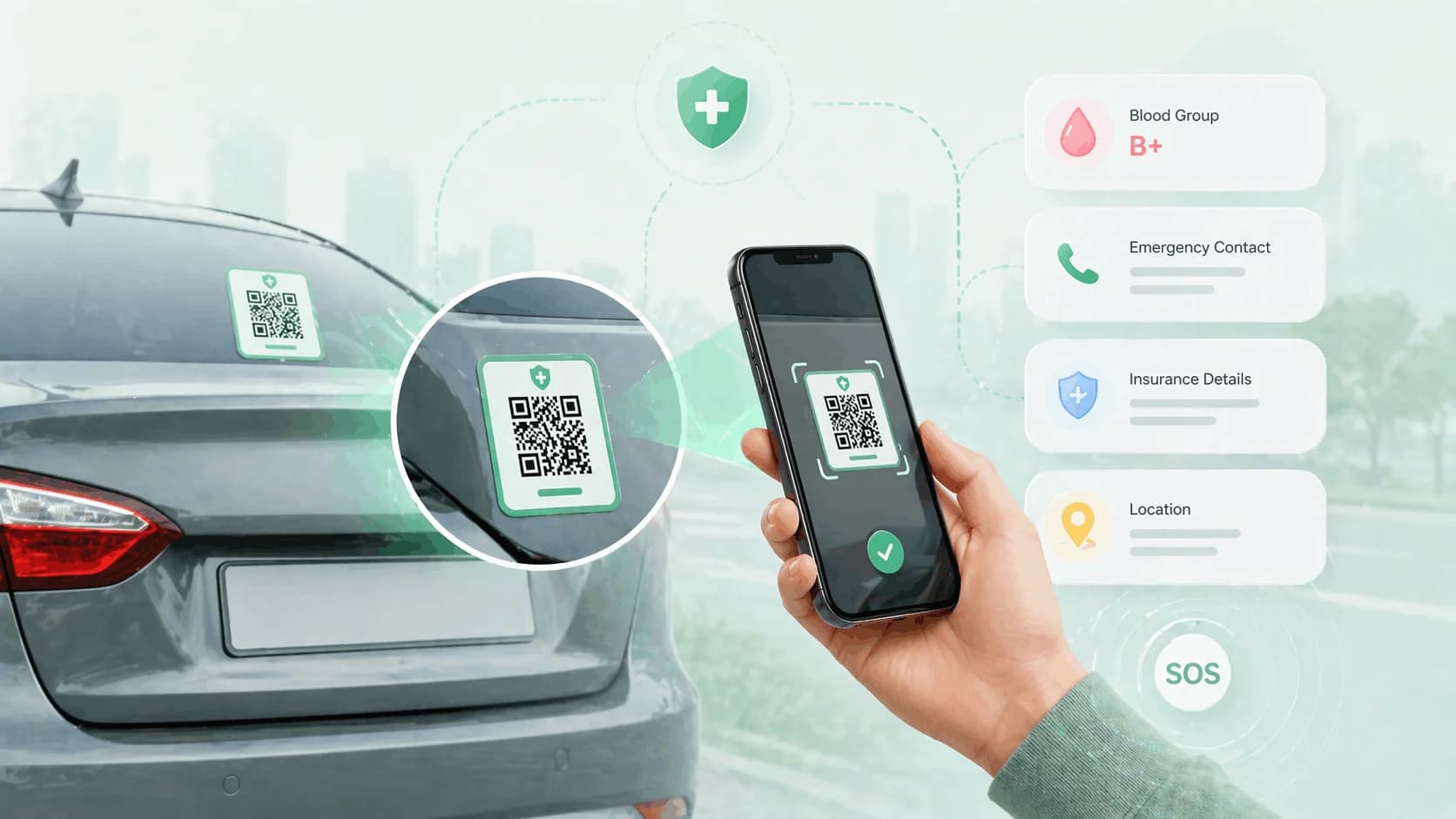
A vehicle emergency QR sticker is a code on your dashboard or rear window that opens an emergency profile when a bystander scans it: your name, blood group, allergies, an emergency contact they can call in one tap, and your insurance details. It works even if you are unconscious, your phone is locked and they have never met you. In a road accident the people around you usually want to help; what they lack is the information to do it, and this is the fastest way to hand it to them.
Before an accident, not after
- The sticker holds nothing; the profile behind it holds everything, and you update it online.
- Blood group, allergies, two contacts and the insurer's 24-hour number are the fields that matter in the first 30 minutes.
- Dashboard plus rear window; a bystander is far more likely to see both than to search a glovebox.
- Setup is about ten minutes, once.
Why a vehicle emergency contact sticker matters
Picture this. You are driving on a highway near Delhi at night and your car is hit from behind. You are unconscious. The bystanders who stop are good people, but your phone is locked, so they cannot reach your contacts; your wallet may hold a licence but not a blood group; they do not know whether a condition affects your treatment or which hospital your insurance covers. Every minute spent working that out is a minute your family does not know what happened. A vehicle profile behind a sticker is scanned in seconds and answers those questions, with one-tap calling to the person who should be told first.
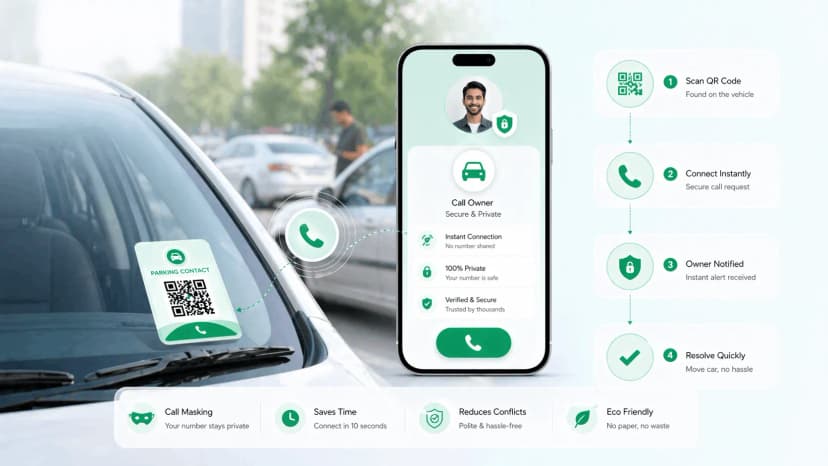
In many parts of India, bystanders take the first actions at a crash scene before an ambulance arrives, so having this information on the spot matters. The same car emergency QR code also serves the quieter, far more frequent problem of a car blocking someone in a parking lot, because the profile can show a contact without showing your number.
What to include in the emergency profile
Everything that matters in the first 30 minutes after an accident. It looks like a long list; it takes about ten minutes to fill once, then only changes when your life does.
| Section | Include | Why it matters |
|---|---|---|
| Identification | Full name and a clear photo | Confirms the profile belongs to the person in the car |
| Emergency contacts | Primary and secondary: name, relationship, number, and which languages each one speaks | The first call is the one that matters; a second number covers an unanswered first |
| Medical | Blood group (prominent), drug and food allergies, chronic conditions, current medication and dosage, implants or recent surgery | Changes what a paramedic can safely give you |
| Healthcare preferences | Preferred hospital, your doctor's name and number | Where you are taken if there is a choice |
| Insurance | Vehicle and health or personal-accident insurer and the 24-hour assistance line; add policy numbers only if you are comfortable showing them | Admission and towing move faster |
| Vehicle | Registration number, make, model, colour | Matches the profile to the car at a multi-vehicle scene |
QR sticker versus a handwritten note
Some drivers already keep a handwritten note behind the sun visor with a blood group and a family number. That was always better than nothing. An emergency sticker for car use with a QR code is the same idea with the limits removed.
| Handwritten note | QR emergency sticker | |
|---|---|---|
| Information it holds | Two or three lines | A full profile; no field limit |
| When something changes | Rewrite it, or it goes stale | Edit online; the sticker stays the same |
| Readability after a summer | Faded, smudged, peeling | Machine-read; prints survive heat if laminated |
| Privacy | Anyone at the window reads everything | Opens only on scan; you choose what shows |
| Medical detail | Blood group, one contact | Full medication, allergies, conditions, several contacts |
| Insurance | Rarely; no space | Yes, with the helpline number |
Where to place the sticker
Placement does most of the work. The sticker has to be visible to a bystander or paramedic at the scene without a search. The lower centre of the dashboard, visible through the windscreen from outside, is the primary position and the spot a helper is most likely to look. The lower corner of the rear window is the secondary position: it is what someone approaching from behind sees, which is the common rear-end scenario, and it lets a bystander act without opening the car. A small laminated card on the sun visor is a reasonable third. Avoid anywhere that blocks your view, and avoid the glovebox, which requires searching.
Who it is for, and who should pair it with something else
Where a vehicle emergency sticker earns its place
- Daily commuters and highway drivers, especially those who drive alone
- Anyone with a condition or medication a paramedic should know about before treating
- Families who want to be the first call after an accident
- Drivers who already keep a visor note and want it current and complete
Where it needs adapting
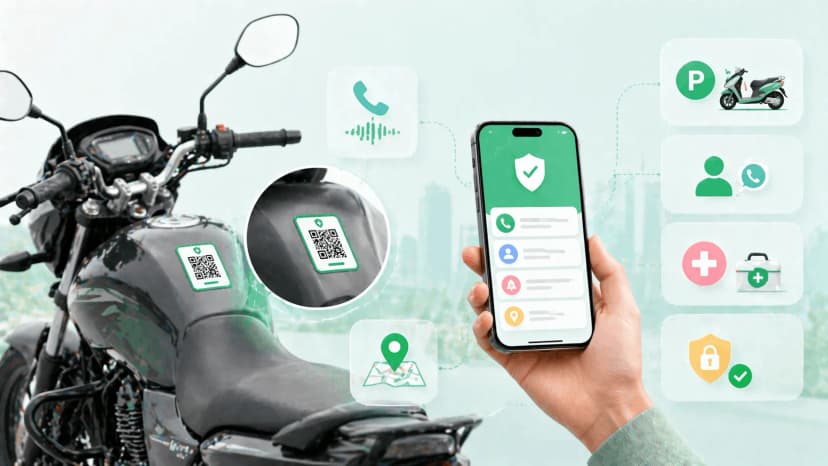
- Two-wheeler riders, where a sticker has nowhere protected to live; a tag on the helmet or key ring does the same job
- Anyone whose medical details change weekly; keep the profile current or the information misleads
- Shared or fleet cars with changing drivers; the profile describes one person, who may not be the one driving
Setting it up
- Create a ProfileTap account and a Vehicle profile, named something like "Your Name, vehicle emergency info".
- Work through the table above and fill every row; this profile is for the worst day, so completeness matters.
- Add a clear photo. It confirms identity and makes the profile a person to the stranger helping.
- Download the QR code from Share Profile, print it on card stock and laminate it at any print shop so it survives heat and moisture.
- Place one on the dashboard and one on the rear window, then scan each with your own phone to confirm the profile loads and the call buttons work.
- Send the profile link to your family so they know it exists and what it says.
If you would rather not print, the vehicle QR sticker ships already linked to the profile and doubles as the parking-contact sticker.
Where the sticker falls short
A sticker is only read if someone thinks to scan it, and it only helps if the profile is current. It does not replace carrying your licence and insurance papers, and it will not summon an ambulance on its own. It makes the first helpful stranger useful; it is one part of the plan.
Set it up before you need it
An emergency contact QR sticker for car windows takes about ten minutes to set up, and it is the kind of preparation you do once and leave in place. The vehicle profile is built for it, and the same profile covers the everyday case too: see the parking contact QR code guide and, for two-wheelers, the bike QR code tag.