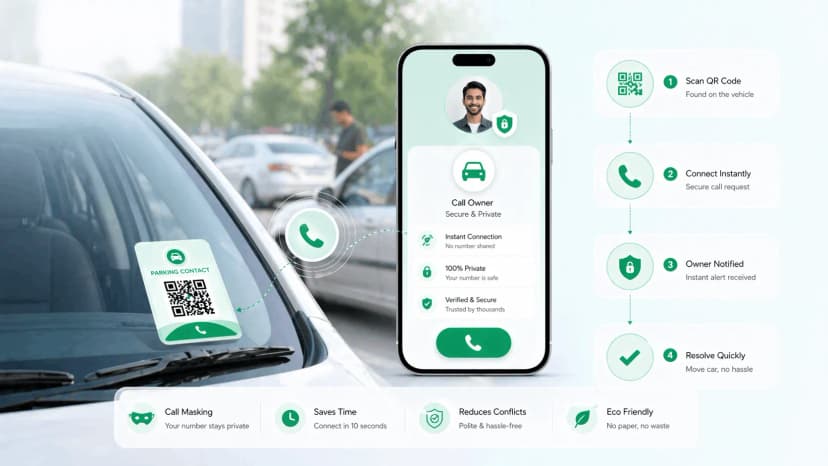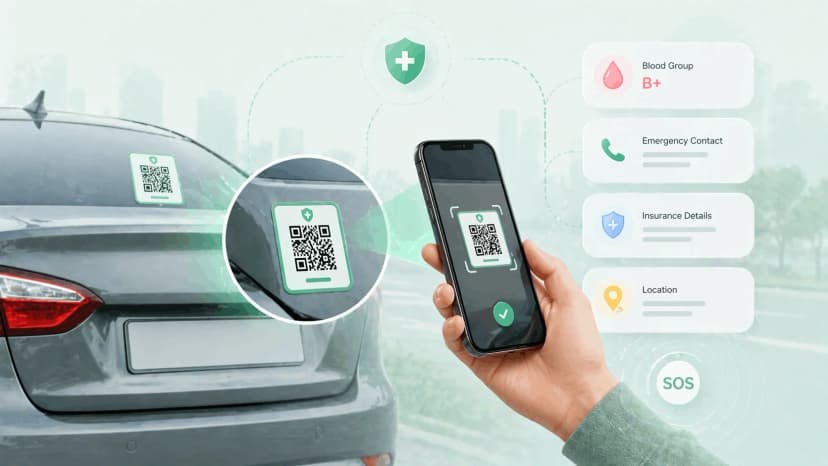

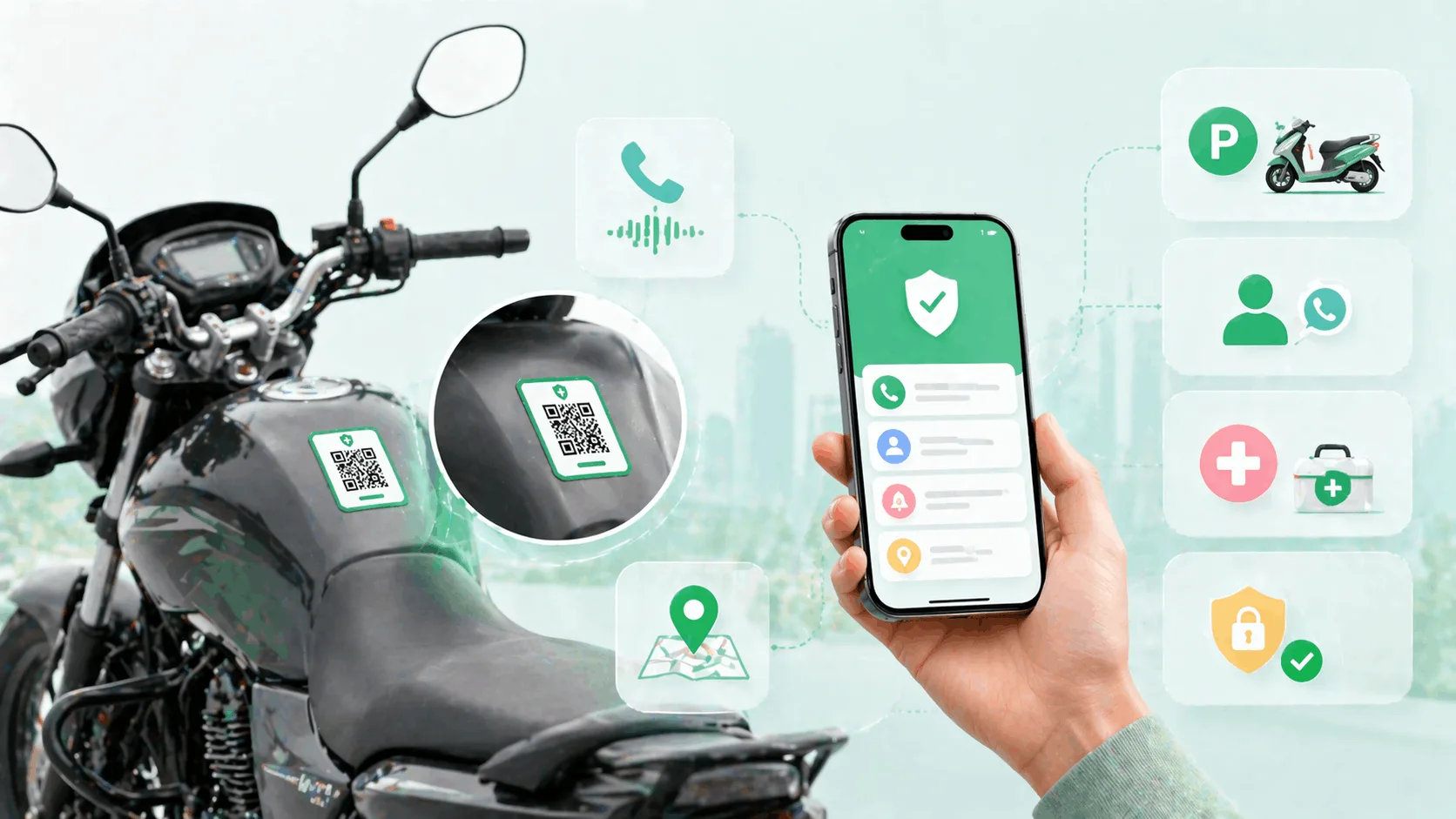
A bike QR code tag is a weatherproof sticker or helmet card linked to a vehicle profile. Anyone who needs you to move your bike, or needs to help you after a fall, scans it with a phone camera and reaches you or your emergency contact in seconds, while number masking keeps your real mobile off their screen. Bikes and scooters get parked in stairwells, on footpaths, in office corridors and across car exits, and when one is in the way there is usually no owner in sight and no way to find them. With a tag, the person scans, taps to call, and the society WhatsApp group never has to get involved.
Before you stick one on
- Two-wheelers get parked in more awkward places than cars and are harder to trace to an owner, so a scannable contact pays off quickly on a bike.
- One profile covers three jobs: parking contact, emergency details after an accident, and quick proof of who the bike belongs to.
- Storage-box lid for scooters, inside the helmet for emergency info; always laminated or weatherproof.
- Number masking is what makes a tag on a bike in a public space safe to carry.
Why two-wheeler owners get more out of a QR tag than car owners
Wrong parking is more frequent. A car has defined spaces, even in chaotic Indian parking. Bikes go anywhere: footpaths in Mumbai, office corridors in Gurgaon, shop entrances in Connaught Place, the bike bay of a Bangalore housing society where fifteen bikes are crammed into a space meant for eight. Sooner or later, the bike is in someone's way.
The owner is harder to trace. When a car blocks the gate, the guard checks the vehicle register for the flat number. Bikes are often not in the register at all, and a plate number does not lead a neighbour to the owner. A QR code tag for bike parking is the most direct path to the rider. Theft is a concern too, and a profile with your name and the bike's registration is a useful extra record of ownership. And riders face a higher injury risk than car occupants; in an accident, a code on the bike or in the helmet gives a bystander the emergency contact and medical details while the rider cannot speak.
Three ways riders use it
| Use | What the scanner sees | Where the tag should be |
|---|---|---|
| Parking contact | A call and WhatsApp button, with your number masked | Storage-box lid, near the number plate, or a handlebar tag |
| Emergency information after an accident | Blood group, allergies, conditions, emergency contact | Inside the helmet, plus the bike |
| Ownership and identification | Your name, contact and the bike's make, model and registration | Anywhere on the bike a guard or attendant checks |
Parking is the everyday case. In a Pune society your downstairs neighbour's car is blocked by your Activa every other week; with a tag they scan and call you directly, and the building group stays quiet. The emergency case matters most for solo riders on highways and night rides, where nobody nearby knows who you are. The ownership case comes up when a bike is towed and you need to prove it is yours, or when building management wants to know which resident a bike belongs to.
Setting up a bike profile
- Create a ProfileTap account; sign-up takes about two minutes.
- Create a vehicle profile with the bike's make, model, colour and registration number.
- Add the parking contact and a short message such as "Parked nearby, call and I will move it straight away."
- Add blood group, drug allergies, any conditions and at least one emergency contact with their relationship to you. It takes about five minutes, and it is the part a bystander needs most.
- Turn on number masking so callers reach you without your personal number landing in their phone.
- Download the QR code from Share Profile, print it on weatherproof material, and attach it using the placement guide below.
If you would rather skip the printing, the vehicle QR sticker arrives already linked to a profile and survives rain and sun.
Where to put a two wheeler QR sticker
Placement needs more thought on a bike than on a car: there are few flat surfaces, everything is exposed to weather, and strangers such as guards and parking attendants handle the bike more often.
| Placement | Weather protected? | Visible to a blocked driver? | Best for |
|---|---|---|---|
| Storage-box lid (Activa, Jupiter and similar) | Yes, when closed | Yes | Scooter QR tag for parking |
| Near the rear number plate | Partial | Yes | Ownership checks |
| Inside the helmet, in the card slot or on velcro | Yes | No | Emergency information |
| Rigid handlebar tag on a cable tie | Partial | Yes | Parking contact on motorcycles |
| Fuel tank | No | Yes | Only with a laminated weatherproof sticker |
Sticker on the bike versus card in the helmet
Sticker on the bike
- Visible to anyone the bike is blocking, which is the everyday problem
- Lets a guard or attendant identify the owner without a register
- Stays with the bike if it is towed or stolen
- Needs lamination and a dry spot to last a monsoon
Card inside the helmet
- Goes with you off the bike, so it works on a highway or a night ride where nobody knows you
- The first thing a bystander handles after a fall
- Fully protected from weather and from curious scanning
- Useless for parking; a blocked neighbour cannot see it
Most riders should do both, pointed at the same profile. The sticker handles parking; the helmet card handles the day you cannot speak for yourself.
Number masking on a bike that lives in public
A sticker on a bike in a society, an office complex or a market will be scanned by a neighbour you have blocked, a guard checking which resident the bike belongs to, a parking attendant, or a stranger at an accident scene. All of those are good reasons to reach you; none of them need your personal mobile saved in their phone for good. With masking turned on, the call is routed through a privacy number, so the caller gets through and your own number never appears on their screen or in their call log. That is what makes a public-facing tag workable for riders who would otherwise keep no contact on the bike at all.
What a bike tag will not do
A QR tag is not a tracker and will not tell you where a stolen bike went. It only works if the other person has a phone with internet and bothers to scan, and a faded or peeling sticker is as good as no sticker. Print on weatherproof material, check it after the first monsoon, and keep the profile current.
Set up your bike's tag in under fifteen minutes
Searches for "bike QR code tag India" come down to two needs every rider knows: ending blocked-parking standoffs and speaking for you at a roadside. The vehicle profile is the place to start, the Car Sampark Tag is the four-wheeler version of the same idea, and the parking contact QR code guide and vehicle emergency sticker guide go deeper on each use. If someone sends you a photo of a tag instead of scanning it, the code can be scanned straight from the image.