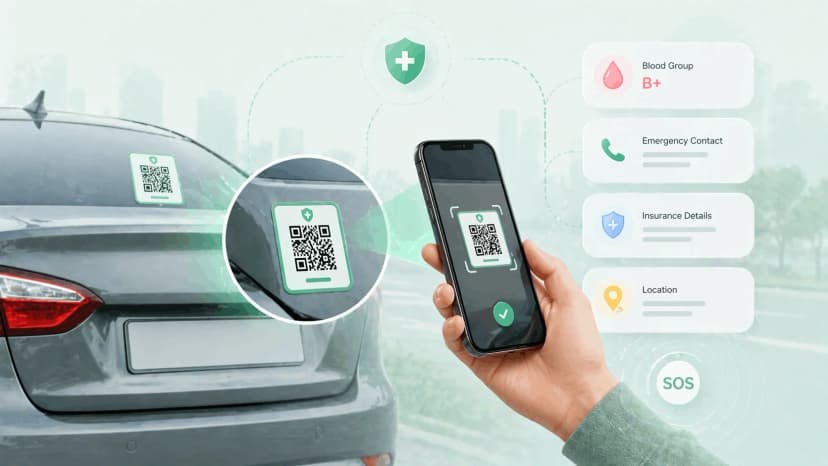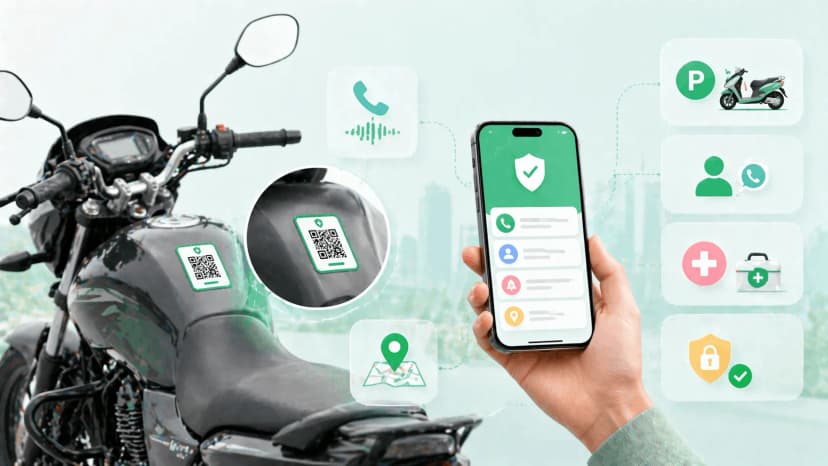

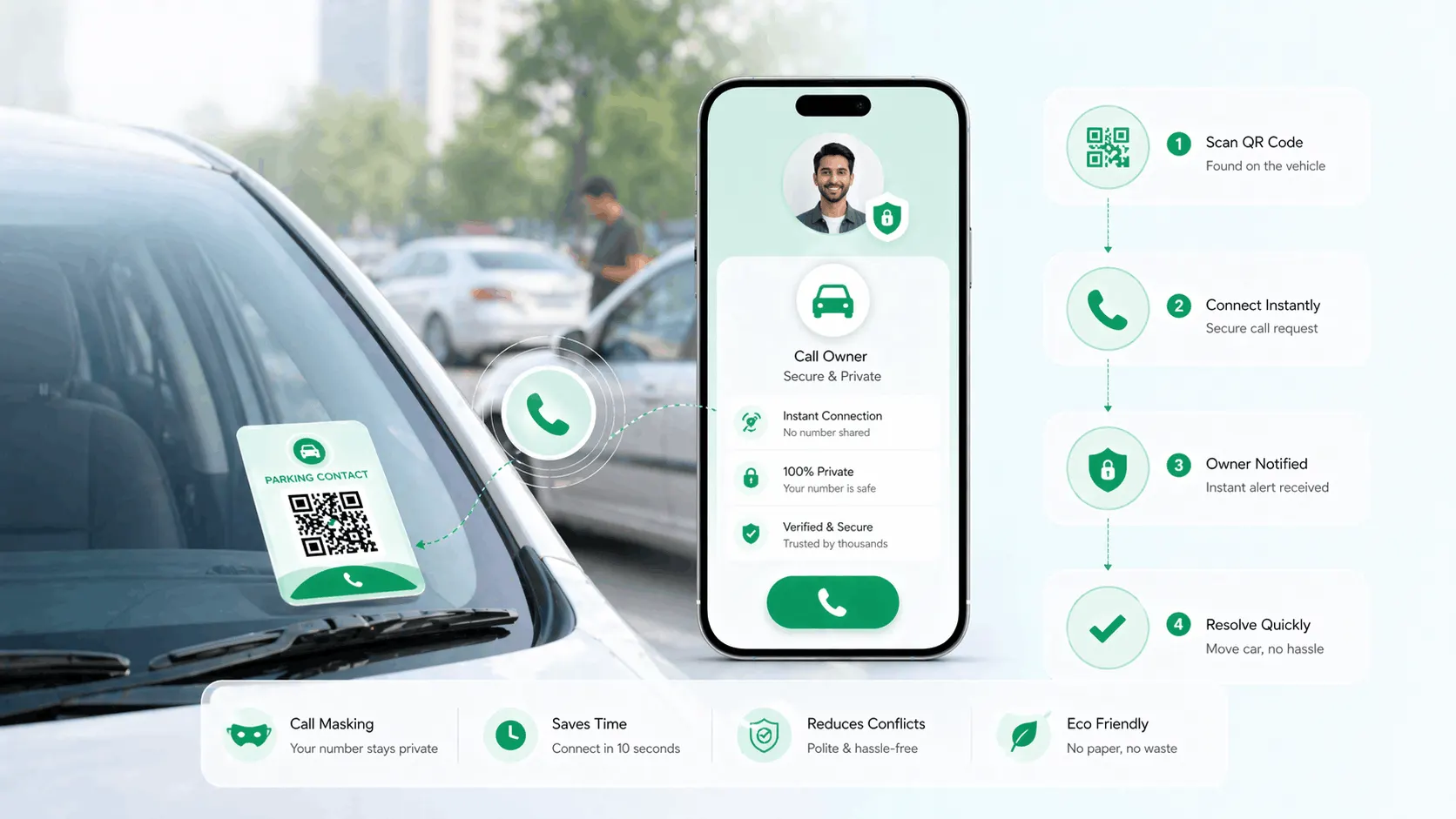
A parking contact QR code is a scannable sticker on your windscreen that links to a vehicle profile. When your car blocks someone, they scan it and reach you by call or WhatsApp in seconds, and number masking means your personal number is never handed to a stranger. Picture the usual case: a wrongly parked car in a Mumbai housing society, no number on the glass, and a guard who does not know whose it is. With a sticker on that windscreen, the wait ends with one call. It is the simplest wrong parking solution for crowded Indian streets.
The short version
- Any blocked driver scans the parking QR sticker and reaches you in one tap; no app on either side.
- Number masking connects the call through a privacy number, so your real mobile is never shared.
- It works everywhere parking gets tight: societies, markets, offices, hospitals, event venues.
- Setup is under fifteen minutes, and you change the number or message without reprinting.
The wrong parking problem in India
It plays out the same way in Mumbai, Delhi, Bangalore, Hyderabad, Pune and Chennai: wherever space is tight relative to the number of vehicles. The current fixes, a number scribbled on paper on the dashboard, the guard broadcasting a plate number, or simply waiting, share one flaw. They need you to have planned ahead, and the paper note hands your number to a complete stranger permanently.
| Where | What goes wrong | Who ends up mediating |
|---|---|---|
| Housing societies | Visitor bays filled by residents, double-parking, emergency vehicles blocked | The gate guard, unwillingly |
| Markets and high streets | The parker is "just running in for five minutes"; the blocked driver cannot find them | Nobody; people wait and honk |
| Office complexes and IT parks | Basement and surface lots; colleagues chase each other through floors | Reception, over the PA |
| Hospitals | A blocked car whose owner urgently needs to leave | Security, while minutes pass |
| Temples, wedding halls, event venues | Informal parking at scale; blocking is near certain | Whoever shouts loudest |
How a QR code for car parking works
The sticker sits on the inside of the windscreen, visible to anyone standing by the car. A blocked driver points a phone camera at it; your contact profile opens with a one-tap call or WhatsApp button; they tap; your phone rings; you move the car. Scan to solution in under a minute, with no note, no guard relay and no permanent exchange of numbers. A vehicle QR code sticker makes sure that when someone needs you to move, they can reach you.
Why number masking is the whole point
A number printed on a card in the windscreen works fine on a Tuesday morning. On Saturday evening the same number is on your car in a dimly lit market lot, and a stranger now has your personal mobile for good. Number masking fixes that. When someone scans the code and calls through the profile, the call connects, you answer, you move the car, and your real number was never shown. For a sticker that stays on your car every hour of every day, in every place you park, that privacy is what makes it safe to leave there.
QR sticker versus the usual workarounds
| Paper note on the dashboard | Guard announces the plate | Parking QR sticker | |
|---|---|---|---|
| Time to reach you | Minutes, if the note is legible | Longer, and only if the guard is there | Seconds |
| Your number stays private | No | Partial; the plate, not the number | Yes |
| Works outside your own society | Yes | No | Yes |
| Survives a summer on the dash | No | Not applicable | Yes, if printed on weatherproof stock |
| Change the number later | Rewrite it | Not applicable | Edit the profile; same sticker |
Who it suits
Where a parking contact sticker earns its place
- Society residents and visitors where double-parking is routine
- Anyone who parks in markets, office basements or hospital lots
- Two-wheeler owners in tight shared bike stands
- Drivers who currently leave a paper note and worry about who reads it
Where it adds little
- Cars that live in a private garage and never park on the street
- Drivers who will not answer an unknown masked call; the system only works if you pick up
- Anyone expecting it to stop the blocking itself; it only shortens the wait
Setting it up
- Create a ProfileTap account and a Vehicle profile; add the car's make, model and colour so the scanner knows they have the right one.
- Add the number you want reached for parking and switch on number masking in the profile settings.
- Add a short line such as "Parked nearby, happy to move right away, please call or WhatsApp." It tells the other driver you are easy to reach.
- Download the QR code from Share Profile and print it on weatherproof sticker paper, or use a laminated card in a dashboard holder.
- Apply it to the inside of the windscreen or rear window, facing out, about 5 to 6 cm square, where it does not block your view.
- Scan it yourself from outside at a normal standing distance and confirm the call button connects.
If you would rather skip printing, the Car Sampark Tag ships already linked to a masked vehicle profile.
What else the same profile does
Parking contact is the everyday case, but the same vehicle profile can also list emergency contacts for the day you cannot speak for yourself, which the vehicle emergency sticker guide covers in depth. A parking QR code also works as a quick ownership reference, and on a bike in a packed apartment stand it lets security or a blocked rider reach you without an intercom announcement.
What the sticker cannot do
The sticker only helps if the blocked driver notices it and you answer the call. It will not move the car for you, and a blurry home print can fail to scan in low light. Print it clean, place it where a standing adult sees it, and treat an unknown call when you are parked somewhere tight as probably about the car.
Solve wrong parking in under fifteen minutes
A vehicle profile behind a windscreen sticker lets anyone reach you in seconds while your number stays private. Two-wheeler owners have their own version in the bike QR code tag guide.