
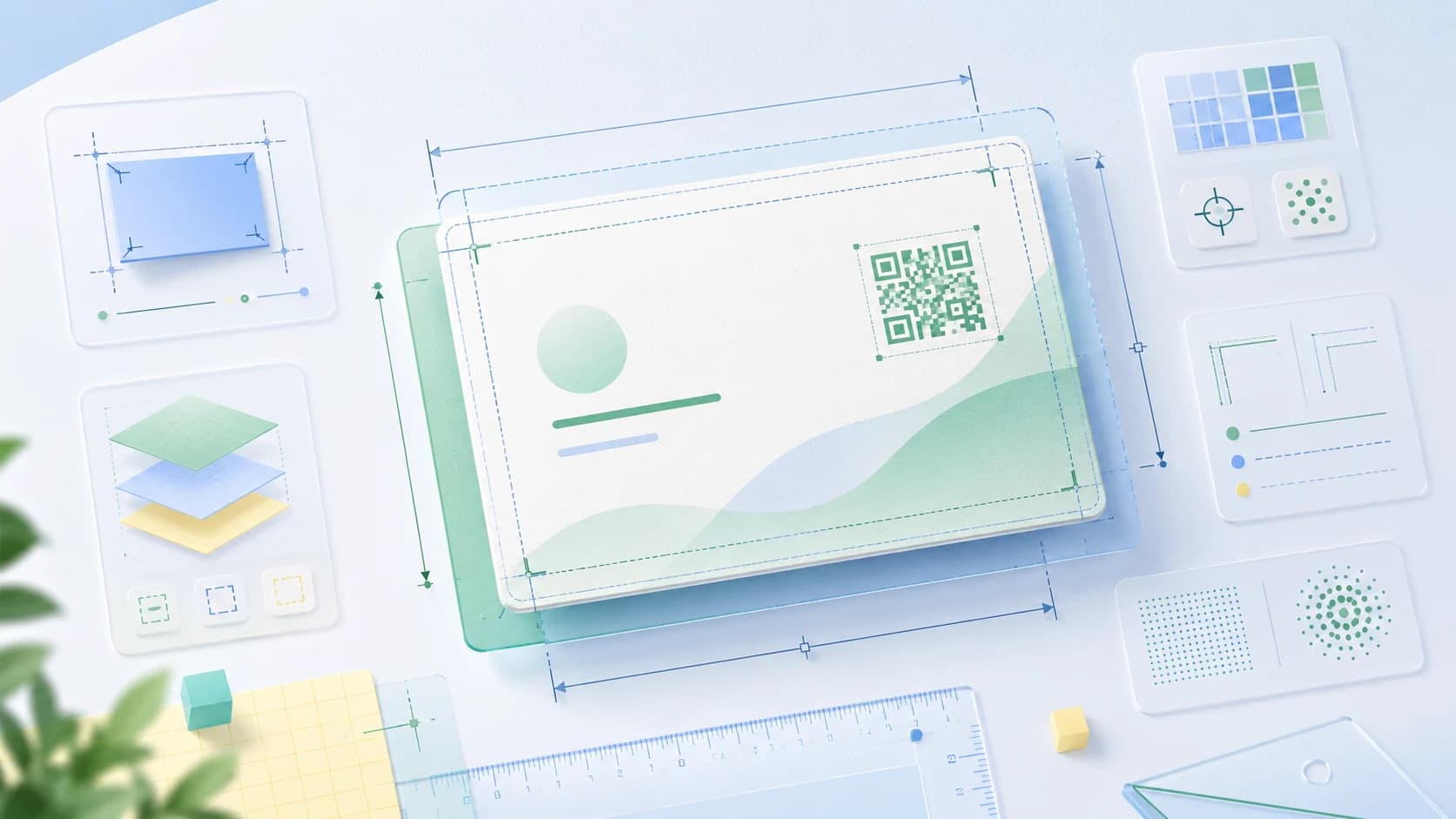
The standard visiting card size in India is 3.5 x 2 inches, which is 89 x 51 mm, or 8.9 x 5.1 cm. Most Indian printers treat this as the default, and a slightly wider 90 x 54 mm is the common second option. Internationally the standard shifts to 85 x 55 mm, so a card designed for India may need resizing before it travels. Below is the same size in every unit you will be asked for, the print-file settings that stop a card being trimmed badly, and the size a QR code needs to scan reliably.
The numbers to remember
The visiting card size in inches is 3.5 x 2, the visiting card size in cm is 8.9 x 5.1, and the visiting card size in mm is 89 x 51. Those are the visiting card measurements to put in a print file.
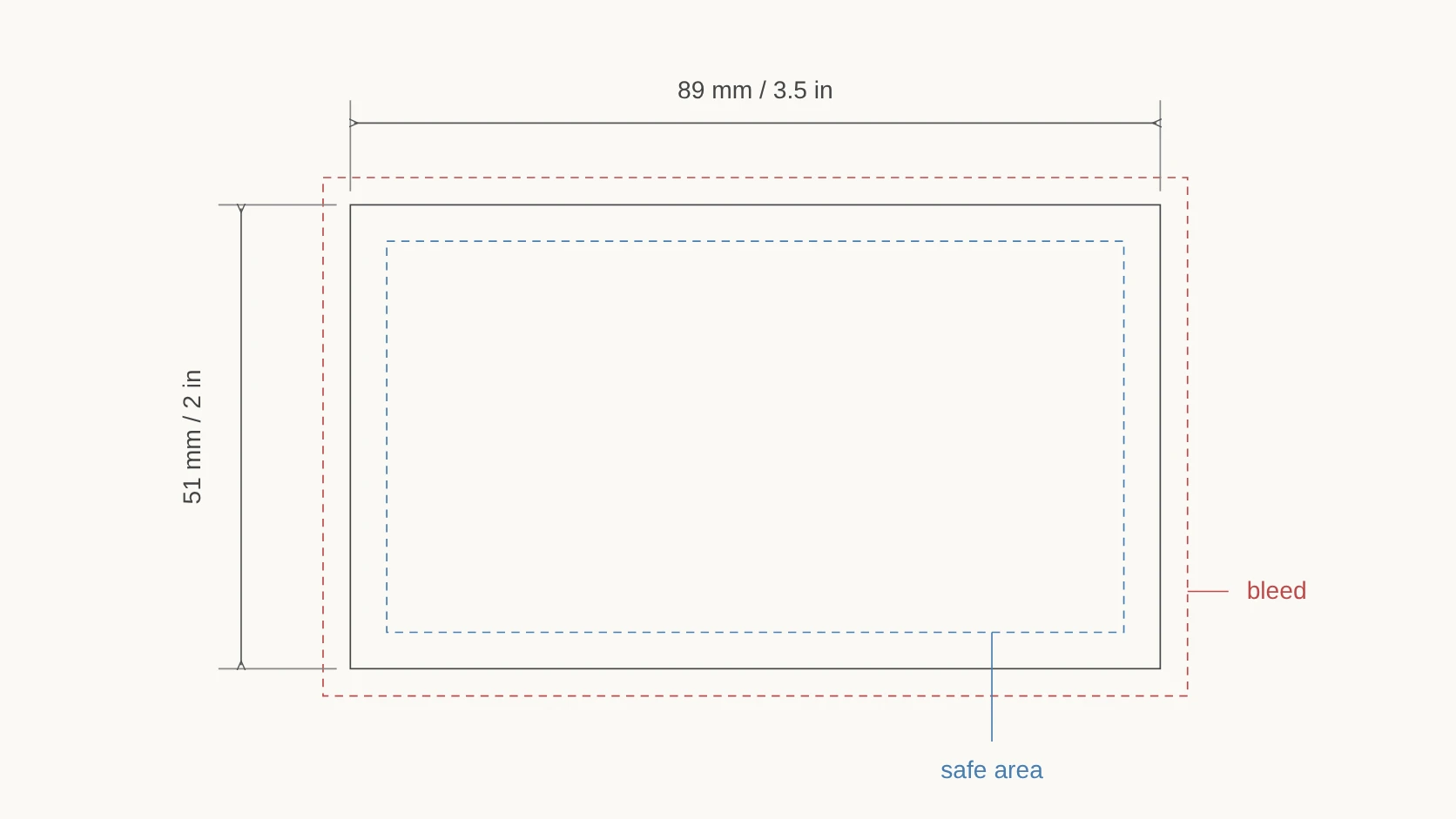
Add 3 mm bleed on every side (95 x 57 mm canvas), keep text 3 to 5 mm inside the trim, export at 300 DPI in CMYK.
A QR code on the card needs 15 to 20 mm square with a clear quiet zone, or it will struggle to scan at a dim table.
The India visiting card size does not change from city to city or between paper stocks, so the right size for visiting card printing is the same wherever you print.
Visiting card size in inches, cm, mm and pixels
Printers quote in millimetres, design tools default to pixels, and most people remember the size in inches. This is the same three cards in every unit, so you can copy the row you need straight into your file.
| Unit | Standard India (89 x 51 mm) | Alternate India (90 x 54 mm) | International (85 x 55 mm) |
|---|---|---|---|
| Inches | 3.5 x 2 in | 3.54 x 2.13 in | 3.35 x 2.17 in |
| Centimetres | 8.9 x 5.1 cm | 9 x 5.4 cm | 8.5 x 5.5 cm |
| Millimetres | 89 x 51 mm | 90 x 54 mm | 85 x 55 mm |
| Pixels at 300 DPI (print) | 1050 x 600 px | 1063 x 638 px | 1004 x 650 px |
| Pixels at 72 DPI (screen preview only) | 252 x 144 px | 255 x 153 px | 241 x 156 px |
| With 3 mm bleed, at 300 DPI | 95 x 57 mm, 1122 x 673 px | 96 x 60 mm, 1134 x 709 px | 91 x 61 mm, 1075 x 720 px |
What is the standard visiting card size in India?
The Indian visiting card size you will be quoted at almost any print shop in Mumbai, Delhi, Bengaluru or Pune is 89 x 51 mm, so if you are unsure which size visiting card to order, start there. In centimetres, that is 8.9 x 5.1 cm (or 9 x 5.4 cm for the larger variant). A few presses default to 90 x 54 mm because it fits more cards on their print sheet. Both are correct; the practical difference is 1 to 3 mm, which matters only if your design runs edge to edge. Weighing a local press against an online service? We compared them in visiting card maker near me.
- Ask your printer for their exact trim size before you design; presses differ by a millimetre or two.
- Standard thickness runs 300 to 400 GSM for paper stock; below 300 GSM the card feels flimsy in hand.
- Portrait cards use the same numbers flipped: 51 x 89 mm. They stand out, but they do not sit flat in most card holders and wallets.
Visiting card ka size kya hota hai?
India mein standard visiting card ka size 3.5 x 2 inch hota hai, yaani 89 x 51 mm ya 8.9 x 5.1 cm. Print file ke liye 300 DPI par 1050 x 600 pixels rakhein, har side 3 mm bleed jodein, aur text ko kinare se kam se kam 3 mm andar rakhein. Kuch printers 90 x 54 mm bhi offer karte hain; order se pehle unse confirm kar lein.
Visiting card dimensions by country
There is no single worldwide business card standard size. There are four regional conventions, and India follows the North American one:
| Region | Millimetres | Inches |
|---|---|---|
| India / US / Canada | 89 x 51 mm | 3.5 x 2 in |
| India (alternate) | 90 x 54 mm | 3.54 x 2.13 in |
| Europe / international | 85 x 55 mm | 3.35 x 2.17 in |
| ISO 7810 ID-1 (credit card) | 85.6 x 54 mm | 3.37 x 2.13 in |
| Japan | 91 x 55 mm | 3.58 x 2.17 in |
| Australia / New Zealand | 90 x 55 mm | 3.54 x 2.17 in |
Is the Indian visiting card size different from the US size?
No. The business card size India uses is the same 3.5 x 2 inch (89 x 51 mm) standard as the US and Canada. The difference shows up against Europe, where 85 x 55 mm is normal; a European card is shorter and taller, so an Indian design will need adjusting if you plan to print it abroad.
Designing a card at all? An NFC business card uses a footprint that fits every wallet and card holder, and the details on it are updated from your phone, so a new number never means a reprint.
How much bleed does a business card need?
3 mm on every side. Print files usually come back for one of the three settings below, and the card's size is rarely the problem. What fills that canvas matters just as much; our visiting card background guide covers the image sizes, formats and colours that print cleanly on it.
| Setting | Value | Why |
|---|---|---|
| Bleed | 3 mm on every side; 89 x 51 mm card on a 95 x 57 mm canvas | Any background colour or image must run to the outer edge |
| Safe area | 3 to 5 mm inside the trim line | Guillotine trimming drifts by a millimetre or two on a real run |
| Resolution | 300 DPI, CMYK | 72 DPI screen artwork prints soft; converting to CMYK yourself shows the colour shift before the press does |
What resolution should a business card be for printing?
300 DPI in CMYK. Anything exported at 72 DPI, which is what a screen uses, prints soft and the small text on a card goes fuzzy first. Set the canvas in pixels at 300 DPI from the start rather than scaling a web graphic up later.
Size of visiting card in pixels at 300 DPI
- 89 x 51 mm trim, no bleed: 1050 x 600 px
- 95 x 57 mm with 3 mm bleed: approximately 1122 x 673 px
- 85 x 55 mm international trim: approximately 1004 x 650 px
What size should a QR code on a business card be?
The right QR code on business card size is 15 to 20 mm square, roughly 0.6 to 0.8 inch. Below about 15 mm, phone cameras start to struggle in low light or at an angle, which is exactly the situation at an event or a restaurant table. A code printed too small is one of the most common reasons it never gets scanned.
Before you approve a QR on a card
Leave a quiet zone, clear space equal to about four modules of the code, on all four sides. No text, border or logo touching it.
Keep it dark-on-light. Inverted codes and low-contrast pastel pairs scan unreliably.
Shorten the destination URL. Fewer characters means fewer modules and a code that reads cleanly at small sizes.
Print a proof and scan it with two different phones before you approve a full run.
If the code opens a live profile, you can change what it shows without reprinting anything, which is what a QR business card is for.
What size is an NFC business card?
85.6 x 54 mm. An NFC visiting card follows one international format, ISO 7810 ID-1, the size of a debit card, so it fits any wallet slot anywhere in the world; the NFC card size guide covers the dimensions and thickness in full. Because your details live on a profile you can edit, the regional chart above stops mattering for the card itself, which only needs to carry a chip and a QR code.
What a chip changes about sizing
- A new number, designation or address becomes a quick profile edit
- No character limit: portfolio, catalogue, location and social links all fit
- One card works internationally because ID-1 is the same size in every market
- Multi-language support means the same card can open a profile in the language your contact reads
Where printed still wins
- A well-printed card at 400 GSM makes an impression a tap does not
- Nothing to charge, pair or explain
- Cheapest per card for a short run with settled details
Many people end up carrying both. We broke the trade-off down in paper vs digital business cards.
Getting your card made
If you are printing, lock the trim size with your press first, then design to 3 mm bleed at 300 DPI. If you would rather skip the reprint cycle entirely, you can make a visiting card online free in a few minutes and share it by link or QR before you order any physical card at all. The free profile works as a full digital business card on its own, and if you later add a physical NFC card, it is a one-time purchase with a GST invoice.