
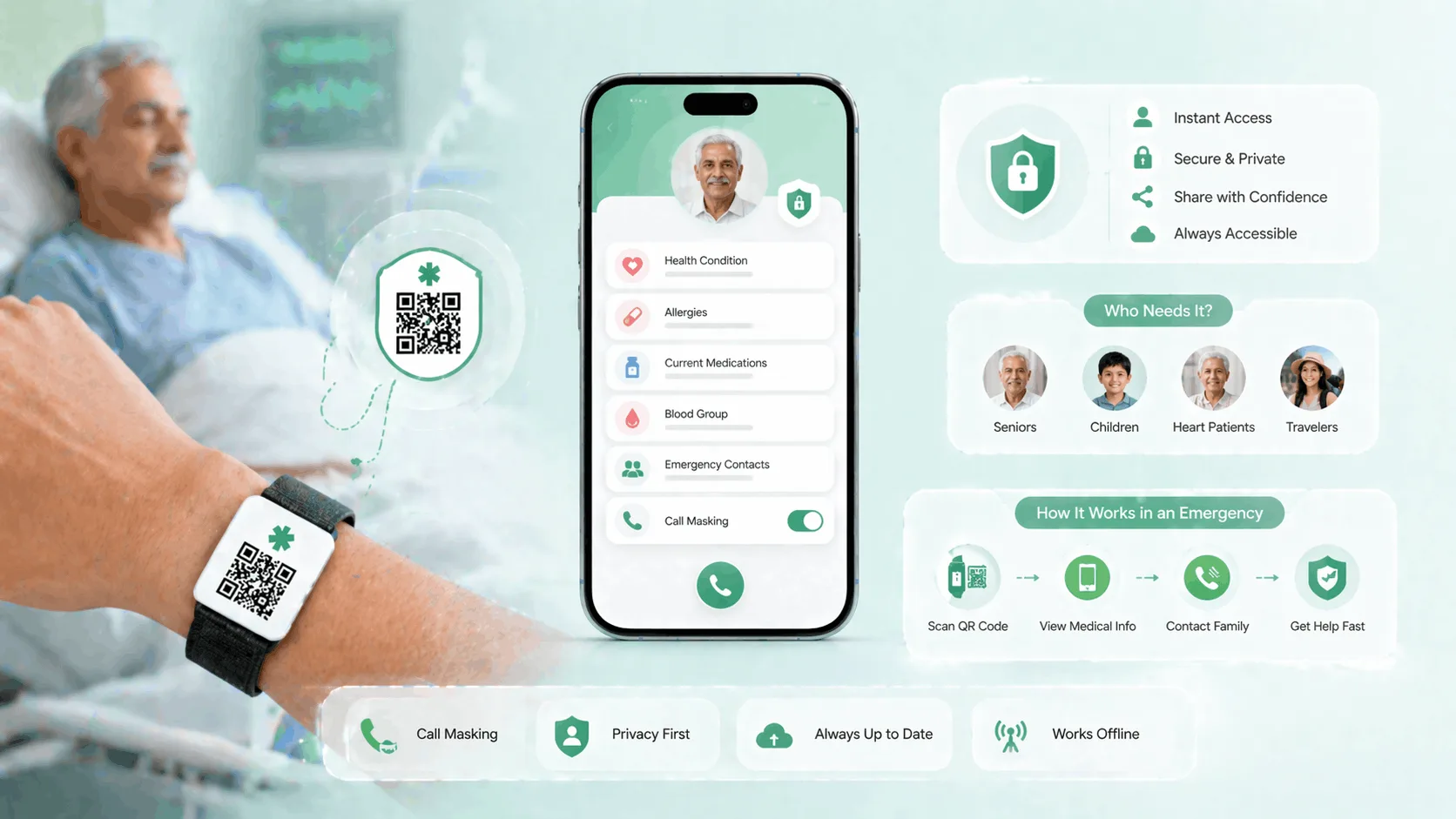
A medical emergency QR code is a scannable code, on a wallet card, phone case or bracelet, that opens a profile with your blood group, allergies, conditions and emergency contacts in any phone browser. If you lose consciousness in a road accident, have a cardiac event in a public place or are incapacitated by a severe allergic reaction, the person helping you needs three things immediately: who to call, your blood group, and anything that changes how you should be treated. A medical ID QR code puts all of that in front of a bystander or paramedic in the time it takes to open a phone camera, with no app and without you saying a word. This guide covers what goes on the profile, who should carry one, where to keep it, and the setup.
The short version
- The code links to a live profile, so a new medication or a changed number shows on the next scan without reprinting anything.
- Blood group, drug allergies, conditions and one contact are the fields that change treatment; everything else is optional.
- Elderly parents, anyone with a chronic condition or a serious allergy, children and frequent travellers get the most from it.
- Put it where a first responder looks first: the wallet or the back of the phone. Setup takes under fifteen minutes.
What a medical emergency QR code is
It is a QR code tied to a digital profile holding your critical medical and contact information. Anyone who scans it with a phone camera sees the profile open in their browser; nothing to install, nothing to log in to. A traditional medical ID bracelet or paper card does the same job with a few engraved or printed lines, and it does it until the information changes. The QR version holds as much as you want to put on it, updates in real time, and shows a stranger only the fields you have chosen to make visible. In short, it is an emergency medical QR that any phone can read.
What information goes on it
Include whatever affects emergency response and leave out whatever does not. The table is the checklist; the last column is what a stranger should see when they scan.
| Field | What it tells a helper | Visible to a scanner? |
|---|---|---|
| Blood group | Transfusion decisions; O negative and AB negative especially | Yes |
| Drug allergies: penicillin, NSAIDs, contrast dye | Prevents a dangerous drug being given while you are unconscious | Yes |
| Food allergies: nuts, shellfish | Explains a reaction a bystander may be watching | Yes |
| Chronic conditions: diabetes, epilepsy, heart disease, asthma, COPD | Changes the first clinical decision a paramedic makes | Yes |
| Medications that matter in the first minutes: anticoagulants, insulin, seizure medication | Affects what can be given safely | Yes |
| Implanted devices: pacemaker, cochlear implant, joint replacement | Relevant to MRI and defibrillator use | Yes |
| Primary contact, name and relationship | The call that brings family to the hospital | Yes |
| Backup contact on a different number | For when the first line does not answer | Yes |
| Your name and a recent photo | Identity confirmation | Yes |
| Doctor's name and contact | History the hospital can request | Optional |
| Full medication list, insurance policy number | Useful at admission, not at the roadside | Optional |
| Donor status | Only if you are registered | Optional |
| Home address, date of birth | A stranger has no need for them | No |
Who should carry one
Anyone whose medical history could change emergency treatment. Elderly parents and grandparents first: cardiac events, falls and strokes become far more common after sixty, and an older family member who lives alone, takes an auto or the metro, or attends functions in crowded halls can have an emergency with no relative present. A code on their wallet card or keychain means any bystander can reach family and show a paramedic the history.
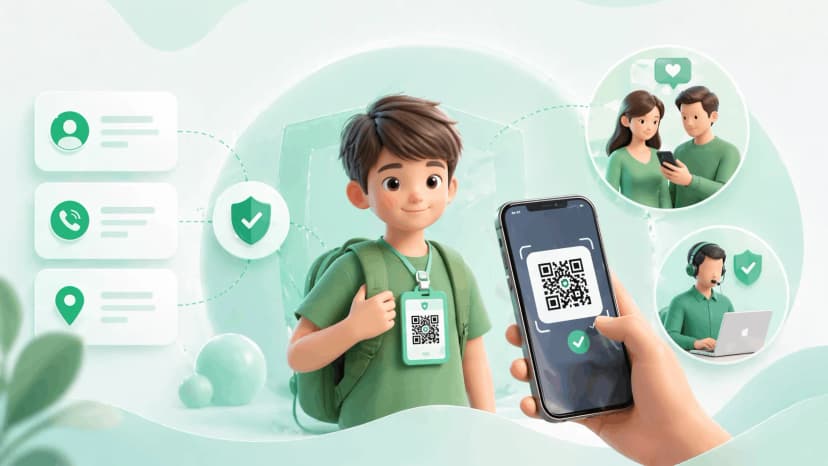
Then anyone with a chronic condition, because a paramedic who knows the patient has epilepsy or is on anticoagulants responds differently in the first minutes. Anyone with a severe drug allergy, since that allergy is invisible until it is life-threatening. Children, whose profile should carry blood group, allergies, conditions and parent contacts; the emergency contact card for kids covers the child-specific setup. And frequent travellers, who may receive care far from their own doctor and want the history to travel with them on a phone case or luggage tag.
How the scan works
You create an emergency profile on a family safety profile with your medical information and contacts. ProfileTap generates a QR code linked to that live profile. You print it or attach it somewhere a first responder will find it. In an emergency the helper points a phone camera at it, the profile opens in the browser with no download and no login, and they see your blood group, allergies and conditions, with a button to reach your emergency contact.
Where to carry a medical QR tag
| Placement | Found quickly by a helper? | Best for |
|---|---|---|
| Wallet card, behind your ID | Yes | Almost everyone |
| Sticker or NFC card on the back of the phone case | Yes | People who are never without their phone |
| Medical ID bracelet with the code printed beside the engraving | Yes | Chronic conditions, elderly parents |
| Car sun visor or glove box | Partial | Drivers; pair with a wallet card |
| Travel wallet or passport cover | Partial | Frequent travellers |
| Work lanyard | Yes | Sites with physical safety risk |
The principle is to place it where someone would look in an emergency. For most people that is the wallet or the phone, and carrying both costs nothing extra because they point at the same profile.
QR profile versus engraved bracelet
Where the QR profile wins
- Updates the moment a medication, diagnosis or number changes; the card in your wallet never goes stale
- Holds a full history, several contacts and a doctor's number; an engraving fits about three lines
- Shows a curious stranger only the fields you made visible
- Any phone reads it with the native camera; no app on either side
Where the engraved bracelet still has a case
- Readable with no phone, no signal and no internet at all
- Instantly recognisable as medical ID even to someone who would not think to scan
- Works as a backup if the wallet and phone are lost in the same incident
- Best answer for many families: both, with the code printed beside the engraving
Privacy: what to show and what to hold back
A medical profile carries more than any other profile type, so the visibility settings matter more. Make public what a helper needs to act: name and photo, blood group, critical allergies, the conditions that change treatment, and a way to reach your primary contact. Keep the full medication list and insurance details restricted for the hospital stage, unless you specifically want them visible. Keep your home address off entirely. And update the profile whenever you start or stop a medication, receive a diagnosis or change a contact; because the code points at the live profile, every existing card and sticker shows the change at once.
Setting it up
- Log in to ProfileTap and create a new profile with the emergency or family safety type.
- Add blood group, allergies, medications and conditions from the table above. Be specific: "penicillin: anaphylaxis" is more useful than "drug allergy".
- Add a primary emergency contact and at least one backup on a different number.
- Set visibility field by field: blood group, critical allergies and the contact button public; full medication list and insurance restricted.
- Download the QR code and put it in the form you will carry every day: a wallet card insert or a phone-case sticker.
- Scan it with a second phone. Confirm the profile opens and the critical fields show. Ask a family member to press the contact button and confirm it connects.
- Tell your contacts you have set this up, so an unexpected call from an unknown number in an emergency gets answered.
For a child, if you would rather not print, the kids bag tag ships already linked to a family safety profile. For adults, a printed wallet card or phone-case sticker made from the same profile does the job.
What a QR code cannot do
A medical emergency QR code only helps if a helper notices it, thinks to scan it and has a phone with internet. It is not a substitute for a medical alert bracelet in places with no signal, it does not replace carrying your prescriptions, and an out-of-date profile can mislead a paramedic. Treat it as the fastest way to get your history and your family in front of a stranger, and keep it current.
Set up your emergency profile
A medical QR tag takes a few minutes to set up and covers the moments when you cannot speak for yourself. The family safety profile gives every member of the household a live, updatable medical profile with a printable code for the wallet, phone or bracelet. For the children in the family, see the child safety tags guide and the emergency contact card for kids.