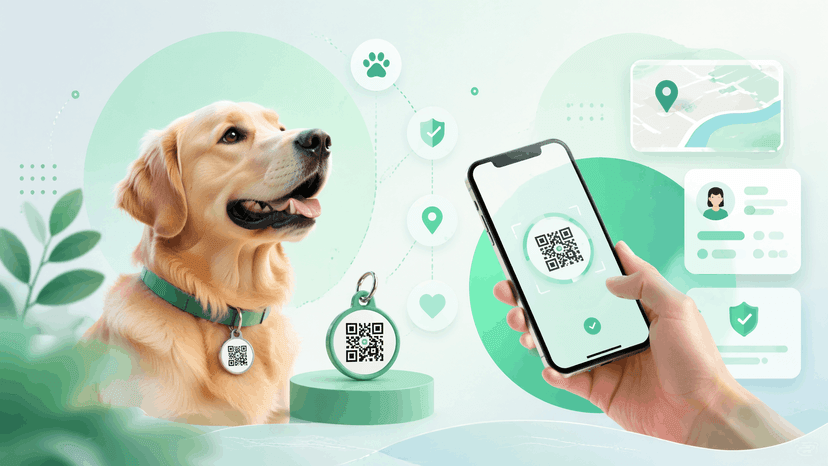

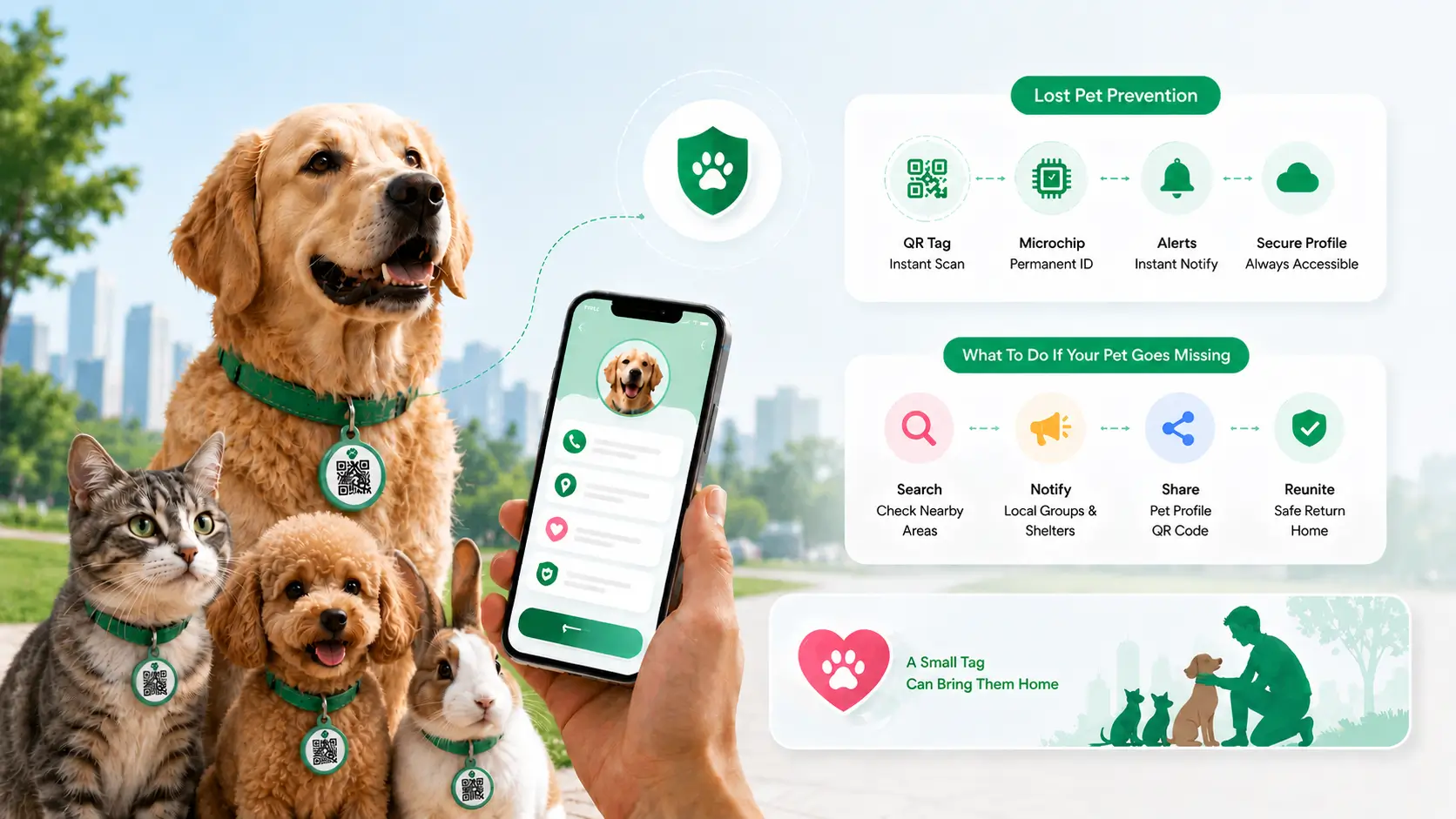
Lost pet prevention means layering identification so that whoever finds your dog or cat can reach you in under a minute: a microchip as the permanent backup, a collar as the visible first signal, and a scannable QR tag that opens your pet's photo and a one-tap call. In India, where Diwali fireworks and an open gate are behind many escapes, a QR tag for lost pet recovery is the upgrade that changes the most, because any stranger's phone can read it, while a microchip needs a vet's scanner.
Four things to get right first
- Many escapes are predictable: an open gate, festival noise, a house move or an off-leash maidan. Prevention starts with those four.
- A microchip helps once someone takes the animal to a scanner; a QR tag helps the moment someone takes out a phone.
- The first hour matters most. Walk the neighbourhood and post in the society WhatsApp group before anything else.
- Out-of-date contact details break every layer at once. Update the registry and the profile whenever your number changes.
Why do pets go missing in India?
The causes repeat, and several are specific to life here. An open gate is the most common: a delivery rider, house help or a neighbour's child leaves it ajar for thirty seconds and a curious dog is out. Festivals come next, Diwali above all; firecracker noise triggers a panic that overrides a dog's normal behaviour, so an animal that has never bolted will dig under the fence that night, and Holi, New Year's Eve and a cricket win can do the same. A house move unsettles a territorial animal that has not yet learned where home is. Off-leash parks and open grounds with several exits let a dog chasing a bird cover a surprising distance before it realises it is lost. And ordinary stress, from thunderstorms and construction noise to a new baby or a new pet, pushes an anxious animal towards exits it would otherwise ignore.
How to prevent losing a pet: the layers ranked by impact
Each layer covers a gap the others leave. Here is how to prevent losing a pet, in roughly descending order of how much each measure changes the outcome.
| Layer | What it does | Who can use it | Its gap |
|---|---|---|---|
| Microchip | Permanent ID under the skin, no collar or battery | Vets and shelters with a scanner | A finder on the street cannot read it; registry details go stale |
| Collar with ID tag, always on | Shows at a glance that the animal is owned | Anyone who reads the tag | Static; a new number means a new tag |
| QR smart tag on the collar | Opens a profile with photo, contacts and a one-tap call | Anyone with a smartphone | Needs the profile kept current |
| Updated details everywhere | Keeps the chain of contact unbroken | You | Easy to forget after a number change |
| Secure fences and latching gates | Removes the exits | You | Needs a walk-round every few months |
| Recall training | Brings the dog back before it is truly lost | You and the dog | Fails under firework panic |
Microchipping is inexpensive at most vets and is the layer to do first, because it survives a lost collar. Its limit is reach: only a scanner reads it, and not every person who finds a dog will take it to a vet. The collar and tag close part of that gap; the QR tag closes the rest.
What should I do the moment my pet goes missing?
In the first hour, walk the immediate neighbourhood calling the name, ask guards and anyone outside, and post in the housing society WhatsApp group; most pets are still close by. Within three hours, post in the city's lost-and-found pet groups on Facebook, call nearby veterinary clinics because finders often go there first, and inform a local shelter or NGO. Within a day, put up printed notices with a photo near the building, the walking park and the market, ask the RWA office to circulate a notice, and post on any community app the area uses. After that, check every group daily and visit shelters in person, since a phone description rarely matches what staff remember. Pets are sometimes found weeks later.
How does a QR tag change the odds of getting a pet home?
Without a tag, the finder does not know what to do. Is the dog stray or owned? They may take it to a vet, post a photo in a group, or leave it, because there is no way to reach the owner, and the clock runs. With a tag, the finder scans the code and sees the pet's name, a photo that confirms the animal, and a call button. They call. You pick up. You know who has your pet and where, and the reunion can happen the same afternoon. People searching "find lost pet" are usually hours into a panic by then; a tag means the finder reaches you first.
Where the QR tag is clearly better
- Any stranger with a phone can act, with no scanner needed
- Shows a photo so the finder knows it is your animal
- One-tap call or WhatsApp, with no number to read and dial
- Update the profile once and every tag already on the collar follows
Where the microchip is still essential
- Stays in the body even if the collar is lost
- The permanent record a shelter checks first
- Nothing to keep charged or attached
How do I set up a lost-and-found profile?
Create a pet ID profile with the pet's name, breed, age, colour and any distinctive marking a finder could use to confirm identity. Add a clear, recent photo in good light that shows the face. Add your number, a backup contact and a WhatsApp option, choosing which of them appear publicly, since WhatsApp is usually the fastest first contact in India. Add the vet's details and any medical note, in case the finder goes to a clinic before reaching you. Then download the code, attach it to the collar on weatherproof sticker paper or as a proper tag, and scan it yourself once to confirm every button works.
Where the tag stops helping
- A QR tag only helps a pet that is found by a person. It does not locate the animal, and it is no substitute for a closed gate on Diwali night.
- A tag that comes off with the collar is gone; keep the microchip registered as the fallback.
- Cats slip collars. Use a breakaway collar and treat the tag as the second layer for a cat; the microchip is the first.
Set up the layers before you need them
Lost pet prevention in India comes down to the three layers above, and the pet QR tag is the layer that turns a stranger's goodwill into a call. For a comparison of every tag type on the market, see best pet ID solutions in India, and for the mechanics of the scan, how pet QR tags work.